2026-11-11
Yaksu Station Dental: Must an Implant Be Removed If Peri-Implantitis Develops? (Maintenance & Re-Surgery)
Peri-implantitis does not always mean removal. Here's how we decide whether to keep and treat an implant or remove and re-place it, plus the re-surgery process and timeline.

Hello.
Barun Dental Clinic, Yaksu Station
This is Kim Tae-young, Director. ^^
In my June post (“Can Implants Also Get Gum Disease?”), we looked at what peri-implantitis is and what causes it.
Today, I'd like to take a closer look at a question I only touched on briefly in that post.
“My gums around the implant keep bleeding. Do I have to have it pulled out in the end?” “The implant feels loose. Do I need to have it placed again?”
When people hear the term peri-implantitis, many of them start by worrying about exactly these things.
To start with the conclusion,
developing peri-implantitis does not automatically mean the implant has to be removed.
After we check how far the inflammation has spread, how much bone remains, and how firmly the implant is held in place,
we decide whether to keep the implant and treat it, or remove it and place a new one.
Today, I'll explain in order the criteria we use and the treatment process for each option.
Peri-Implantitis: Classifying the Condition First
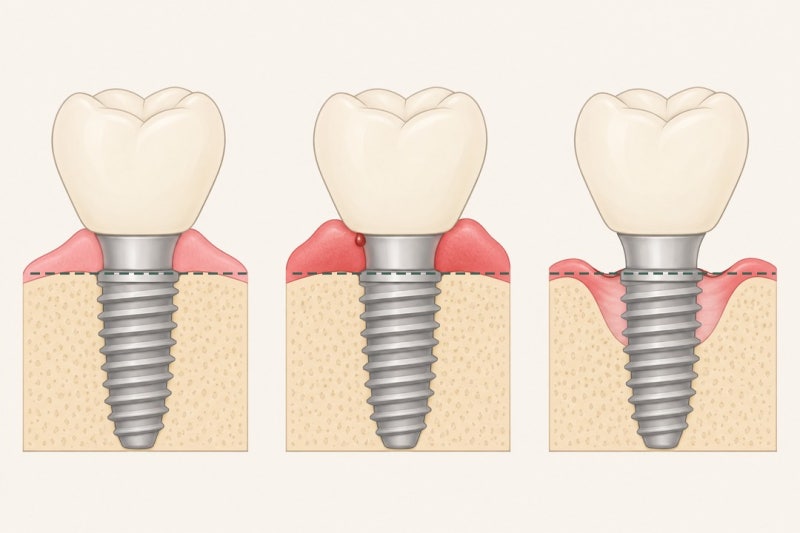
After implant placement, inflammation is classified into two conditions based on how far it has progressed.
Peri-implant mucositis
The inflammation is limited to the gums, with no bone loss caused by it.
Peri-implantitis
Gum inflammation accompanied by loss of the bone that supports the implant.
The image above shows examples of a healthy condition, mucositis, and peri-implantitis, from left to right.
The dotted line is the reference bone level for comparison. In the image on the right, you can see that the bone has receded below the dotted line.
Even within peri-implantitis, the treatment approach can differ depending on how much bone has been lost.
Here's How We Determine Whether to Keep or Replace the Implant
Sometimes bone has receded on the inside even when things look fine on the surface.
That's why we don't rely on visual inspection alone and perform the following tests together.
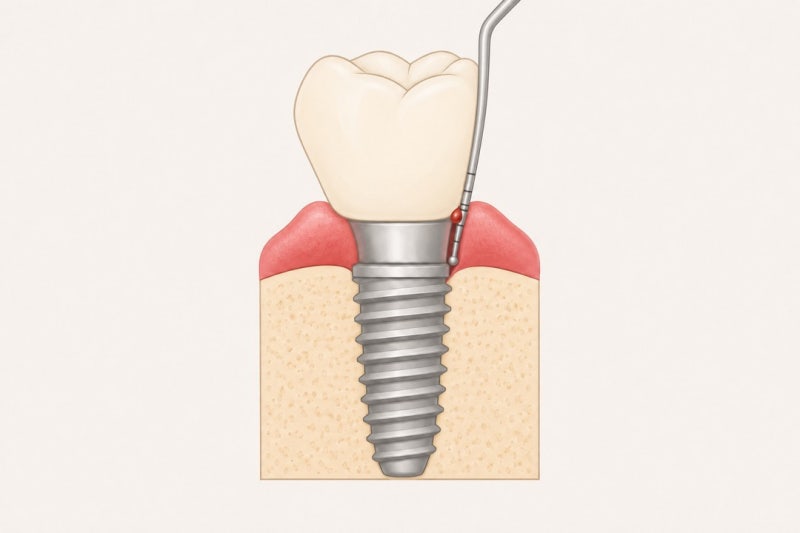
① Gum examination
Using a thin instrument (a periodontal probe), we check whether the gums around the implant bleed.
Just as with periodontal pocket measurements on natural teeth, we also check how deeply the instrument goes into the gum pocket around the implant.
② X-rays (3D CT if needed)
We look at the height and volume of the bone supporting the implant, and the extent to which the inflammation has spread.
If we have earlier images, we can compare them to confirm whether bone has been lost.
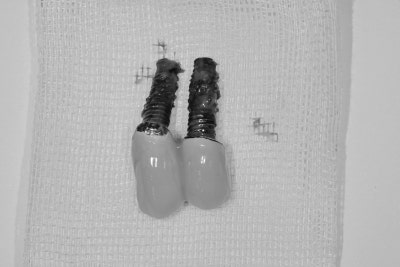
③ Mobility check
If the implant is loose, we determine which part is moving.
If the Implant Is Loose, Which Part Is Moving Matters
When you feel movement, we first distinguish whether the screw holding the restoration has loosened,
or whether the implant body itself, placed in the jawbone, is moving.
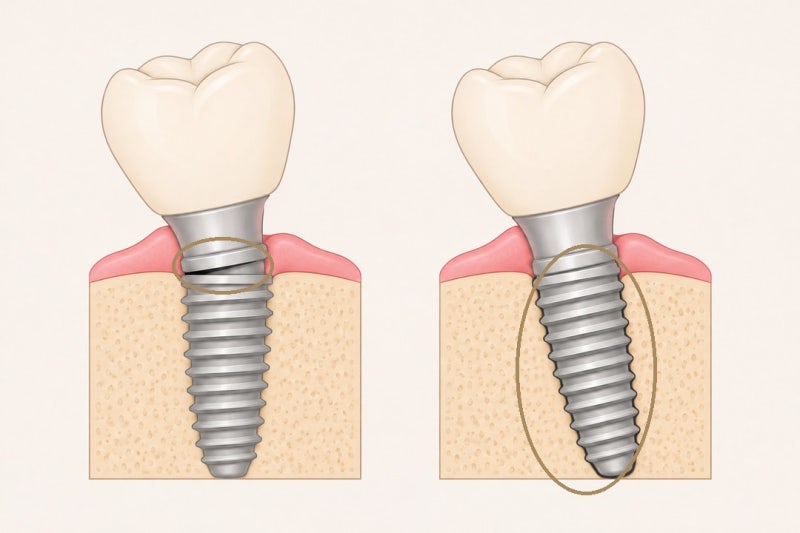
The image on the left shows a case where the screw has loosened and only the upper part moves. The image on the right shows a case where the implant body has also failed to stay anchored in the bone, so the whole implant moves together.
To make the looseness easier to see, the illustrations exaggerate it as a gap or tilt. In reality, an implant can be loose without any visible tilt, so we confirm it through examination.
The circles mark the loosened connection on the left and the implant body that has failed to anchor in the bone on the right.
If only the screw has loosened, retightening it often resolves the problem.
If the implant body itself is loose, however, it has lost its hold on the bone and needs to be removed.
To determine which is the case, we look at both the X-rays and the degree of movement.
When the Implant Is Kept and Treated
If the inflammation is still limited to the gums as mucositis, or if it has reached the bone but is relatively early-stage peri-implantitis,
we often keep the implant in place and treat the surrounding area.
Early stage
We professionally clean the area around the implant and remove tartar.
We also guide you on how to brush around the implant at home and how to use supplementary tools such as interdental brushes.
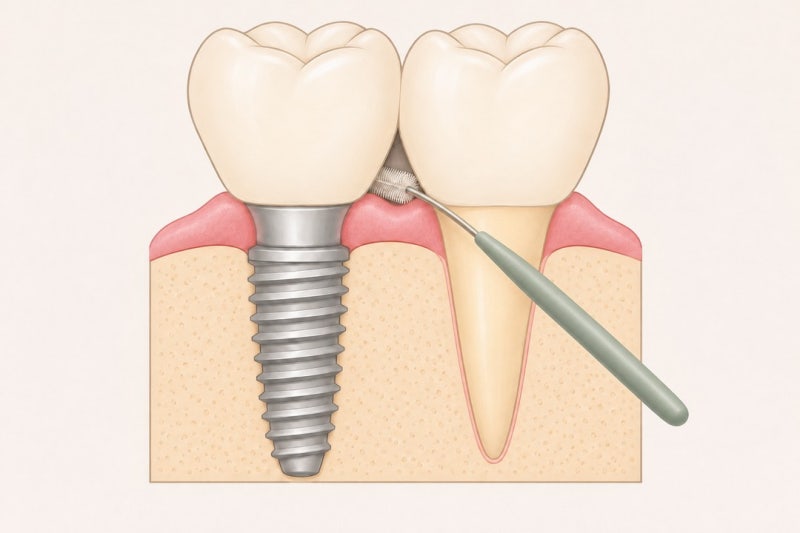
The image above shows an interdental brush being used to clean the space between the implant and the adjacent tooth.
When bone resorption has progressed further
Depending on the condition, we may consider surgical treatment while keeping the implant in place.
In some cases, we also add implant surface decontamination or bone grafting.
When Removal and Re-Placement Are Considered
If the damage to the jawbone has spread widely, or the implant body has lost its stability, the implant is difficult to save.
In such cases, we consider removing the existing implant.
Placing a new implant after removing the old one also counts as re-surgery. Whether a new implant can be placed is decided after we check the remaining jawbone and the state of the inflammation.
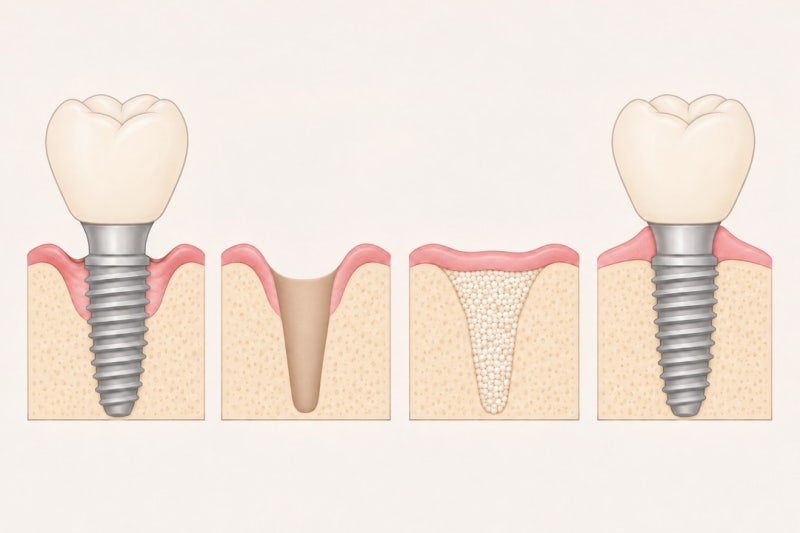
The image above shows an example of a case requiring bone grafting, from left to right:
An implant with bone loss caused by inflammation
After removal and bone grafting,
After re-placement and completion of the final restoration.
① 3D CT diagnosis – We check the amount of remaining jawbone and the extent of inflammation.
② Removal of the existing implant – Along with the implant, we also clean out the surrounding inflamed tissue.
③ Bone grafting if needed – If bone is insufficient, we allow a healing period of about 3–6 months after grafting.
④ Re-placement – A new implant is placed in the healed jawbone.
⑤ Final restoration – We adjust the occlusion (how the upper and lower teeth meet) and attach the restoration.
If no inflammation remains at the site where the implant was removed and there is enough bone to support a new implant, a new implant may sometimes be placed on the same day.
The expected treatment period for re-surgery is about 3–4 months without bone grafting, and about 6–9 months with bone grafting.
Timing varies from person to person depending on the condition of the jawbone and how quickly healing progresses.
Before Re-Placing, We First Identify the Cause
Re-placing the implant does not, by itself, complete the treatment.
If the cause of the problem with the first implant is not resolved, the same issue can happen to the new implant.
That's why we examine the following causes before re-placement.
✔ Bone loss caused by peri-implantitis
✔ Repeated excessive force on the implant due to teeth grinding, clenching, or similar habits (occlusal overload)
✔ The implant did not bond firmly to the bone in the early post-surgical period (early osseointegration failure)
✔ Problems with the placement position or angle, or with the screw or restoration
Smoking, poorly controlled diabetes, and inadequate gum care are also known to raise the risk of failing again.
For this reason, we recommend quitting smoking before and after surgery, and we always check systemic conditions such as diabetes and any medications you are taking before treatment.
When It's Found Changes the Direction of Treatment
With peri-implantitis, what matters is when it is detected.
If it is found while it is still mucositis, the implant can often be kept and treated in place.
If you notice any of the following changes, please don't wait. Get an examination.
· When the gums around the implant are swollen, or bleeding or pus is visible
· When you feel pain while chewing
· When the implant feels like it is moving
Regular checkups are important in long-term implant care.
Even if you have no discomfort, a regular checkup about every six months can help you catch small changes early.
That said, the appropriate interval between checkups can vary from person to person.
At Barun Dental Clinic in Yaksu Station, we first identify the cause of the problem before deciding whether to re-place an implant,
and then determine the treatment that fits your condition.
Thank you.
Barun Dental Clinic, Yaksu Station
Director Kim Tae-young
Barun Dental Clinic Hours and Location
Mon · Wed · Thu · Fri 09:30 ~ 18:30
Tue 09:30 ~ 20:30 (evening hours)
Sat 09:00 ~ 14:00 (no lunch break)
Lunch break 12:30 ~ 14:00
Sun · Public holidays: Closed
Address: 2nd Floor, 179 Dongho-ro, Jung-gu, Seoul
Directions: In front of Yaksu Station, Exit 6
Phone: 02-2232-2828
This post is intended to provide general medical information. Treatment methods, duration, and results vary from person to person depending on the condition of the jawbone and overall health. Post-surgical pain and swelling, failed osseointegration, or detachment of the prosthesis may occur. Please make decisions only after a thorough diagnosis and consultation.
Frequently Asked Questions
Do I have to remove my implant if peri-implantitis develops?
No. Not every case of peri-implantitis requires removal. We look at the extent of the inflammation, the amount of remaining jawbone, and how firmly the implant is held, then decide whether to keep and treat the implant or remove it and place a new one.
How is peri-implantitis different from peri-implant mucositis?
Mucositis is inflammation limited to the gums with no bone loss. Peri-implantitis involves gum inflammation along with loss of the bone that supports the implant. Even within peri-implantitis, the treatment approach can differ depending on how much bone has been lost.
If my implant is loose, do I need to have it placed again?
It depends on whether only the screw has loosened or the implant body itself has failed to bond with the bone. If just the screw has loosened, retightening it often solves the problem. If the implant body is loose, removal is necessary. Whether a new implant can be placed is determined after checking the remaining jawbone and the state of the inflammation.
How long does implant re-surgery take?
The expected treatment period for re-surgery is about 3–4 months without bone grafting, or about 6–9 months with bone grafting. Timing varies from person to person depending on the condition of the jawbone and how quickly you heal.
What tests are done when peri-implantitis is found?
We perform a gum examination, X-rays (3D CT if needed), and a mobility check together. During the gum examination, we use a probe to check for bleeding and measure the depth of the gum pocket. The X-rays show the height and volume of the bone and the extent to which the inflammation has spread.
What should I do if my implant gums are bleeding?
Please don't wait. Get an examination. An exam is also needed if the gums are swollen, bleeding or pus is visible, you feel pain when chewing, or the implant feels like it is moving. Even without discomfort, regular checkups about every six months help you catch small changes early. The appropriate interval between checkups can vary from person to person.